APC METHODOLOGY
Beyond understanding.
Towards lasting change.
A structured psychological methodology grounded in neuroscience, stress physiology and behavioural science, supporting recovery, resilience and self-leadership.

THE CHALLENGE
Understanding is the beginning. Lasting change requires more.
Not everyone who is struggling stops functioning. Many continue working, managing responsibilities and appearing perfectly capable, even as their energy and enjoyment of life diminish. Others eventually reach a point where carrying on is no longer possible.For organisations, the effects are difficult to ignore: declining performance, sickness absence, rising costs and employees who return to work but continue to struggle. Recovery is rarely as simple as getting someone back behind their desk.What is often overlooked is what lies beneath these difficulties, influencing how people cope, recover and respond to life's demands.
Our responses are not shaped by conscious thought alone. They emerge from an interconnected system of neurological, physiological and psychological processes, influenced by our experiences and the ways we have learned to adapt.Under stress or pressure, familiar protective responses can take over, even when we know they are no longer helpful.Lasting change requires more than insight. It requires developing the capacity to respond differently, creating new experiences and integrating that learning into everyday life.
THE APC PERSPECTIVE

A whole-person approach to development
Our thoughts, emotions and behaviours are shaped by the interaction between brain, nervous system, body, relationships, environment and lived experience.Throughout life, we develop ways of responding that help us adapt to our circumstances. What once served a protective purpose may, over time, become a limitation. APC seeks to understand these adaptations and support the development of greater flexibility, regulation and conscious choice.The scientific foundations remain consistent. The developmental journey is personal.
THE METHODOLOGY
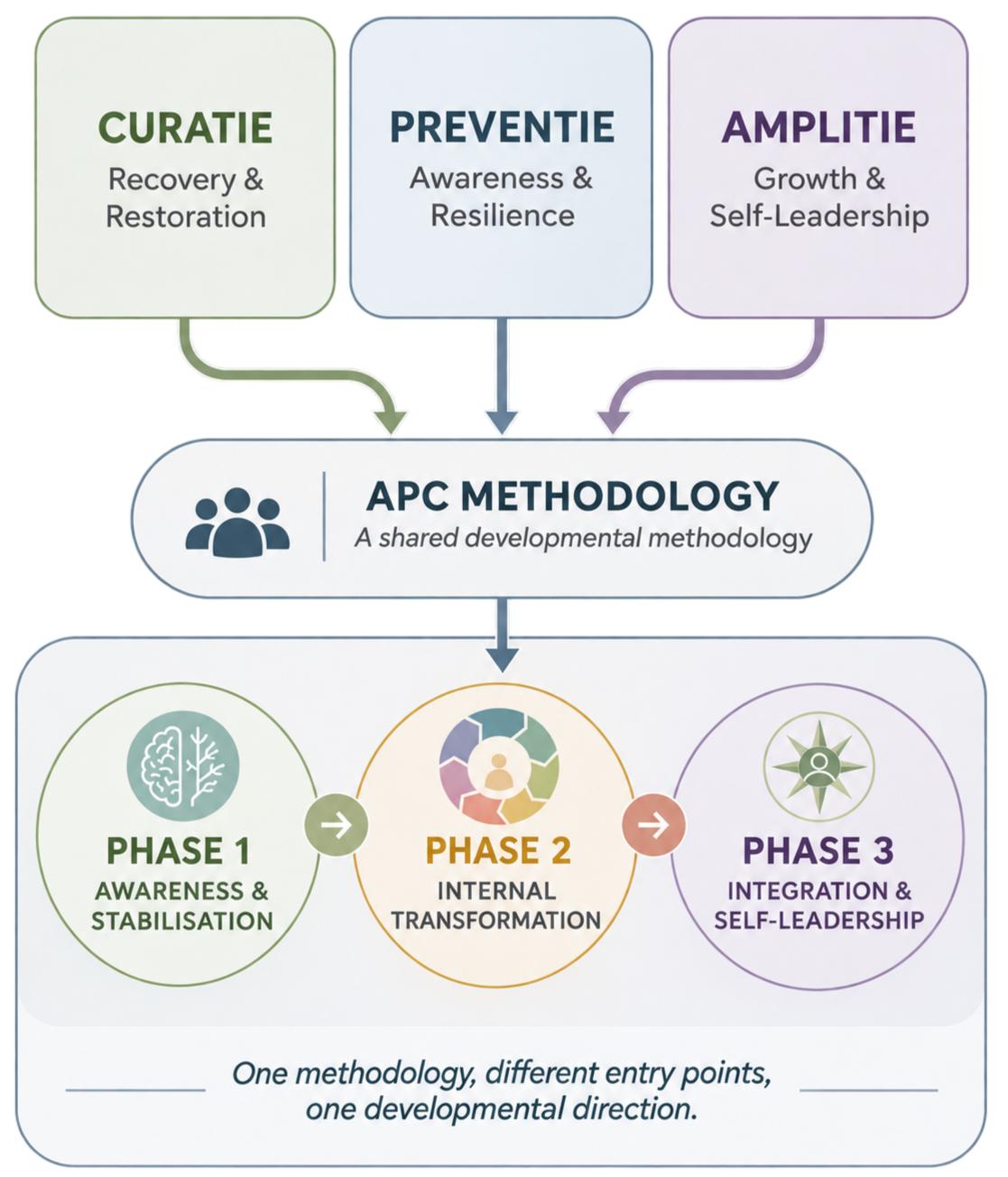
One methodology. Three applications.
APC recognises that learned protective responses can distance us from our authentic needs, values and direction.Curatie: Restoring regulation and functioning when psychological distress has become significant.Preventie: Recognising limiting patterns and developing greater flexibility before distress escalates.Amplitie: Moving beyond habitual protective responses towards a life increasingly guided by personal values and purpose.One developmental methodology. Different starting points, individual pathways.
BUILT ON SCIENCE. DESIGNED FOR SCALE.
Scientific foundations & delivery
APC integrates neuroscience, developmental, Jungian analytical and organisational psychology, incorporating research on nervous-system regulation and neuroplasticity into a unified developmental methodology.Individual trajectories comprise 16 sessions for Curatie, 12 for Preventie and 8 for Amplitie, following the same three-phase structure.Trained and certified APC coaches provide individual guidance and assess each client's progression through the developmental phases.
Measurement, quality & scalability
APC's multidimensional measurement framework collects data from clients and coaches throughout each trajectory, enabling progress reporting and evaluation of effectiveness across multiple indicators, including the personal and organisational factors influencing outcomes.Integrated supervision and quality assurance support consistent professional standards. APC's standardised training, delivery and measurement infrastructure allows capacity to expand through a network of certified practitioners, maintaining methodological consistency and quality at every scale while preserving an individualised approach to each client.

APC METHODOLOGY DEVELOPER
Ninke Sengers, MSc
Organisational Psychology · Social Psychology & Neuroscience
FURTHER INFORMATION & ENQUIRIES
For further information about APC, its applications or implementation within your organisation, please use the enquiry form below.Include a brief description of your enquiry so it can be directed to the appropriate person.